


Last night, just one week after winning three Grammy’s, including being the first Spanish-language album to win the Grammy for Album of the Year, Bad Bunny exhibited his political artistry on a distinctly national stage: the NFL halftime show. In a time of increasing censorship, misinformation, and propaganda, Bad Bunny not only made me proud to be Latina, but he renewed my faith in the power of art itself.
In the span of thirteen minutes and forty seconds, Bad Bunny lead a masterclass in how to craft a socially conscious work of art with heart and purpose. We begin in the sugar plantations — a clear callback to the origins of colonization, Puerto Rican occupation, and racial capitalism in the Caribbean. During the transatlantic slave trade, colonial powers set up a system of racialized labor exploitation and resource extraction on the islands of Puerto Rico, Cuba, Haiti, the Dominican Republic, and other Caribbean countries. In historian Sidney Mintz’s foundational text Sweetness and Power: The Place of Sugar in Modern History (1986), Mintz writes, that these plantations “were first created in the New World during the early years of the sixteenth century and were staffed for the most part with enslaved Africans. Much changed, they were still there when I first went to Puerto Rico, thirty years ago; so were the descendants of those slaves and, as I later learned and saw elsewhere, the descendants of Portuguese, Javanese, Chinese, and Indian contract laborers [whose] ancestors had been brought to the region to grow, cut, and grind sugar cane” (Mintz xxii-xxiii). Mintz wrote this study in 1986, and reminds us that the realities of slavery are not that far away, and persist into the present, in what we eat every day. It’s too common in our society today to dismiss the horrors of slavery, and also to be unaware of the intimacies between US slavery and Latin American colonial infrastructures.
So why do we see these laborers on our screens at the Super Bowl? Because their labor, and their histories of extraction, build the foundation for the persistence of global racialized labor inequalities. And that’s exactly what Bad Bunny shows us next.


Once we leave the sugar plantation, Bad Bunny walks through vignettes of everyday laborers who sustain our life and leisure: he walks past nail technicians, brick layers, street vendors from the Piraguas carts of the Caribbean/ NYC to LA’s Villa’s Tacos, boxers we watch on TV, and jewelry vendors. Bad Bunny uses this stage to remind us of two crucial lessons: first, that cultural workers forge the foundation of a society (the nail techs, the athletes, the fashion) and second, that non-white people are integral to our social fabric. We cannot be expelled, and furthermore, we should be thanked for the labor we perform.
After these opening vignettes, Bad Bunny segues into his feminist anthem, “Yo Perreo Sola.” I really hate to invoke the twice-impeached president, but in the president’s reaction rant to the show he named the dancing “inappropriate for dancing.” It bears stating that the thesis of this song is that women have a right to enjoy their own bodies without fear of assault. So it figures that this display would be reinscribed as perverse because the white supremacist patriarchy cannot imagine why a woman might derive pleasure from her own sexuality, or in other words how a woman might achieve satisfaction without a man. My favorite part of this section is how Bad Bunny stands alone on the top of the stage, without women dancing on him. Secure masculinity understands that mutual thriving can only be achieved when men are able to stand on their own, and recognize that they do not need the spectacle of female desire to assert their power. Just like the women in his song, Bad Bunny is content to dance alone.
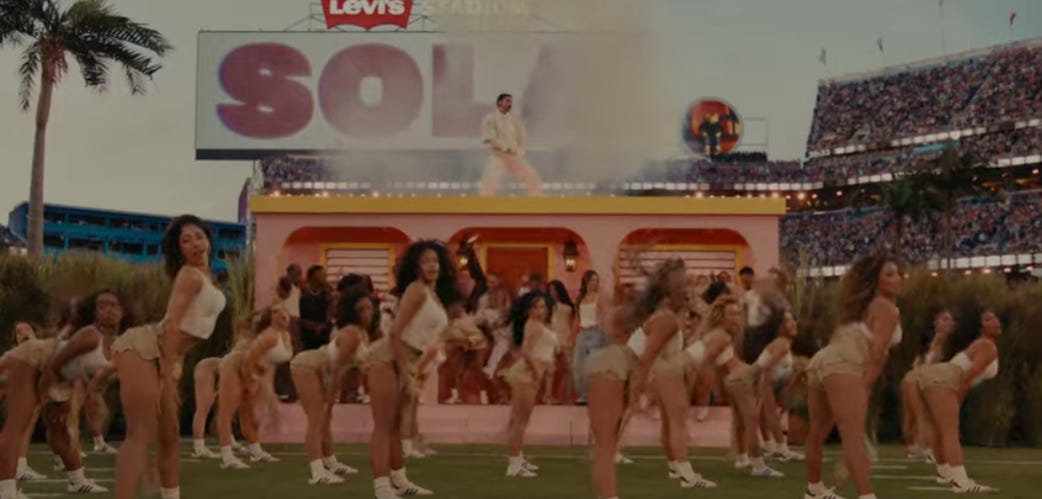
Next, it opens into a full party. I would be remiss if I didn’t note the ways that Bad Bunny did not shy away from perreo. Perreo is a distinct social dance style akin to grinding, but astounding to me for its full-bodiedness and heightened rhythmic demands. Perreo itself is an athletic feat. The inclusion of perreo—and shout out to the two male dancers shown together—captures a throughline of the show, which was the way in which Bad Bunny played with notions of Latinx excess and suciedad, or filth. Queer Latinx studies scholar Deb Vargas writes of “lo sucio,” or “filth,” as a critical symbolic and historical trope of racialization for Latinx people, particularly in the United States. Vargas explains how in sociological, historical, and journalistic writing, Puerto Ricans specifically are often depicted as dirty. This is particularly true of Puerto Ricans when they try to take up space in public, such as during the Puerto Rican Independence Day parade; journalists often described those in attendance as “fat, squat, ugly, dusky, and dirty” (Vargas 717). Vargas argues that gender and sexual normativity, as well as neoliberal economic projects, seek to sanitize all those who fall outside of these boundaries—and that because of race, class, and gender scripts, Latinx people will always fall outside of those boundaries. This does not mean that we are truly perverse, but that we will always be perverse in the eyes of dominant society.
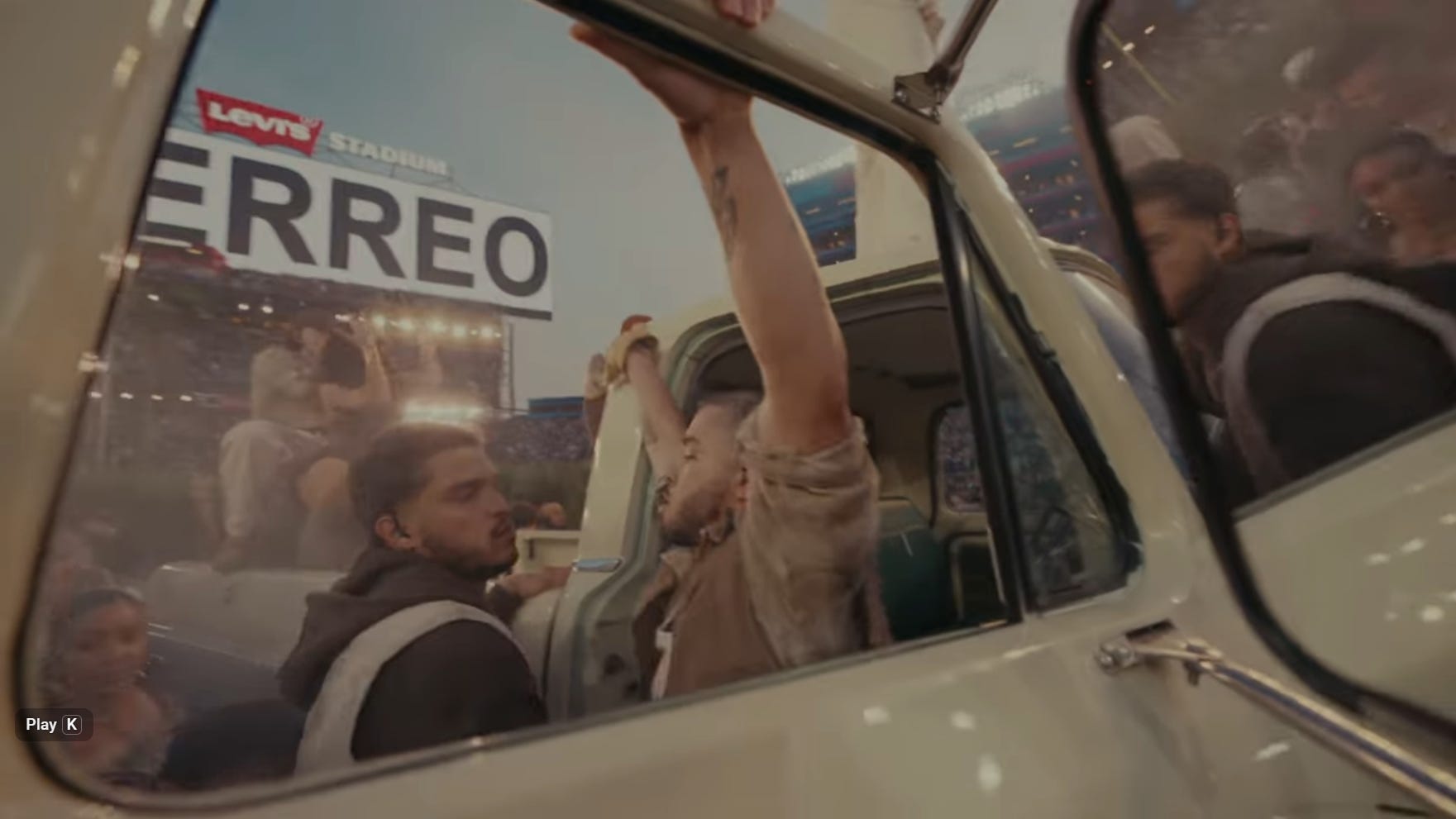
Benito’s displays of sexual excess represent an understanding that as Latinx people, and people of color more broadly, we cannot excise the filth in pursuit of a dignity that will never be acknowledged from the white gaze, so we may as well enjoy where the bump and grind can take us. Further, Bad Bunny doubled down on the image of perreo with his invocation of el caserío, or the projects of Puerto Rico, saying, roughly, “You’re listening to the music of Puerto Rico, of the projects.” Bad Bunny consistently reminds us that his Puerto Rico does not seek assimilation or sanitization, but instead remains indebted to low-class, black and brown aesthetics. Vargas, for her part, writes, “Sucias love in surplus, in turn, within a world that aggressively desires to dispose of them like bad debt.” (Vargas 718). Bad Bunny has certainly displayed for us what that looks like to him, and invited all of us (okay, most of us) to join him.
At the same time, I note that Bad Bunny plays with notions of filth because he does invoke a certain level of what we might call respectability politics, or symbols that appeal to a mainstream “love is love” consciousness. Right after the perreo sequence, with clips from Tego Calderón’s “Pa Que Retozen” and Daddy Yankee’s “Gasolina,” the camera moves to more buttoned up images of violinists in suits, and we are dropped into a literal wedding. After the couple is married, they part and reveal an ultra-blonde Lady Gaga, singing a salsa rendition of her Billboard-topping hit “Die With A Smile.” Gaga is dressed as a 1960s era salsera, with perfectly coiffed waves, and pristine red nails that perfectly match her shoes, evincing a certain Latin diva aesthetic. Benito joins the dancers, conceding to Gaga her well-deserved diva moment, then reappears in a white tuxedo to take her hand as they share a truly electric dance. Benito hands her off, and briefly spins a young girl living my personal dreams of being the most beautiful flower girl ever, and wakes up a sleeping boy, crafting a moment of recognition in the gaze of Latinx spectators who are familiar with all-ages family parties that persist into the wee hours of the early morning.
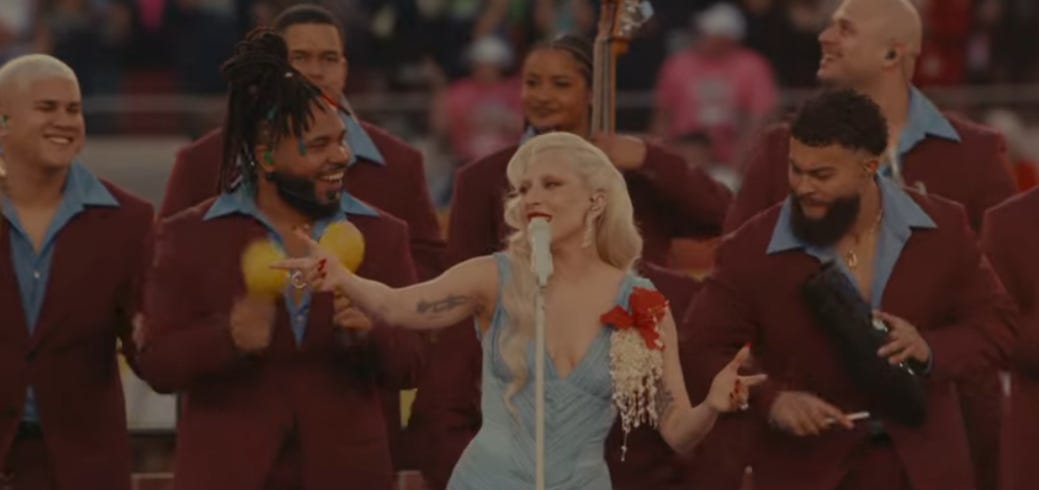
Upon first glance, it is surprising to see Gaga on stage. Bad Bunny has crafted an unapologetically Puerto Rican show, so what is this white lady doing here? Gaga and the heterosexual wedding are symbols that at first glance align with the status quo, and by extension threaten to affirm accusations of Bad Bunny “selling out.”
The Super Bowl and football are displays of nationalism, which are always bound up in the US’s imperial history and ongoing colonial power. Watching Bad Bunny repeatedly holding the football, I was reminded of images of Native boarding school students, Indigenous youth who were held captive in abusive state institutions across North America, who were taught football as a part of a regime of ethnic cleansing. As Native Studies scholar Gerald McMaster writes, these so-called schools were designed “to divorce them from their past" and “totally alienated [them] from their own background” (McMaster 82). There is a shameful violent history that has operated under the guise of forced assimilation, and it can be confusing to see Bad Bunny persistently take up the vestiges of these stories.
But by showing Lady Gaga proudly revising her own hit song—the most popular on the U.S. charts for the past two years—it ultimately represents an alternative kind of cultural fusion that rejects the white supremacist “replacement” fears for a black and brown majority world order. The white supremacist imaginary quakes at the sight of someone like Gaga, who as a thin, blonde, beautiful woman, chooses to use her creativity to produce cultural fusion, rather than uphold white power. Having Gaga sing also exposes the pivotal role that white women play in our society, as actors who can choose to reproduce the social order, or to become allies for change. This segment also importantly calls out the ways in which white supremacy fears black and brown power because they cannot imagine a world in which power would not be used to dominate, but to connect. Though the wedding could be taken as purely a moment of sanitization by asserting proximity to heteronormativity and homonationalism, I appreciate the way that it attempts to display alternate forms of interracial fellowship in a time of crisis.
The show was exceptionally intentional about its visual elements, which is supported in large part by the costuming and color story. Throughout the performance, Bad Bunny and the Latinx performers primarily wore white, a color that in Hollywood primarily symbolizes purity and goodness. For Afro-Caribbean spiritual practitioners, it’s also a deeply spiritually significant color, which in Santería, or the Rule of Ocha, is worn for protection, alignment, and spiritual guidance. Both of these meanings to me call back to his Grammy speech, where he stated that, “We are not savage, we are not animals, we are not aliens, we are humans, and we are Americans.” By wearing white, Bad Bunny exemplifies the cultural hybridity of Latinidad. He simultaneously utilizes a symbol from his cultural context, as well as from the dominant culture, to subvert racist ideas of immigrants and Latinx people more broadly as sub-human. Further, by wearing his own kind of football jersey, he demonstrates the ways in which dominant US culture shapes him as a result of colonization and US imperialism. The irony of the Bad Bunny backlash can be understood as what Catherine Ramirez terms “the paradox of assimilation,” which refers to “the incorporation of members of social groups as subordinate and abject subjects” (Ramirez 15). In other words, Latinx people may become included only insofar as they become “outsiders on the inside” (Ramirez 15). So to become assimilated, or in Bad Bunny’s case, to take this national stage, in many ways only hardens the minoritized subject’s conditions of exclusion.
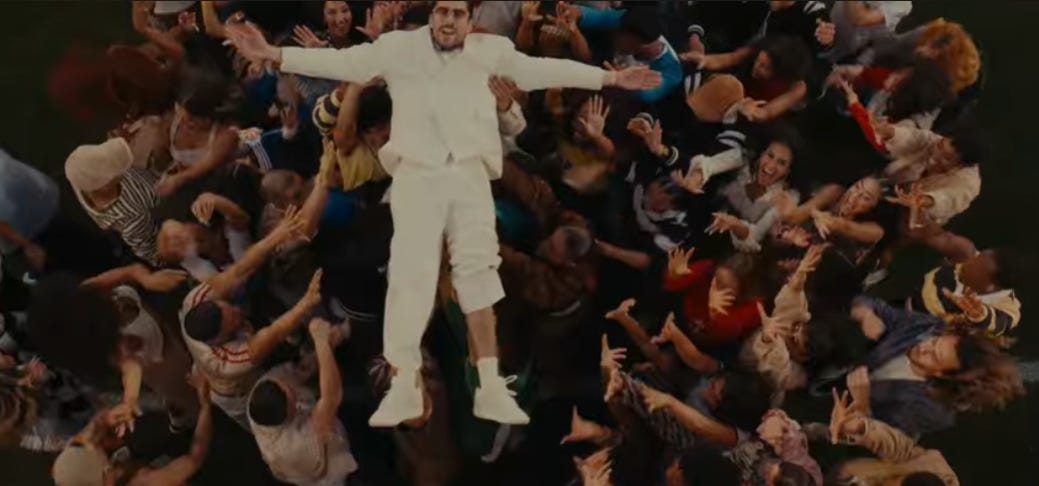
Understanding that true acceptance is a kind of fantasy, I appreciated Bad Bunny’s clear messaging around communal endurance through his repeated turns to moments of intimacy and community care. The hyper-specific images allowed Bad Bunny to introduce himself as an artist, to be seen within his context, but to also persistently uphold a larger community. I noted this especially in his “NUYEVAYoL” section, with the sets of La Marqueta, the Puerto Rican social club, and a barber shop. In these background vignettes, we see neon signs that read “We accept EBT” and meet Brooklyn matriarch Toñita, the proprietor of Brooklyn’s last Puerto Rican social club. In a subtle nod to Afro-Latinx pride, we also see a black man in the barber chair, and a woman braiding her friend’s hair in front of the barber shop.
All of these images together conjure the histories of policing leisure and self-maintenance activities for poor and non-white communities, and by bringing these intimacies to a global stage, Bad Bunny asserts the validity of these practices for his community. In a time when people literally cannot leave their houses to go to the grocery store without being kidnapped, killed, or imprisoned simply for existing, Bad Bunny asserted our right to not just claim space, but to assert vitality and endurance in the face of true evil. Further, by using his voice in such a loud, unabashed medium, Bad Bunny provided a visual language with which to understand the violence of a terrorist organization like ICE—an organization whose true intent is to destroy the social fabric of our communities.


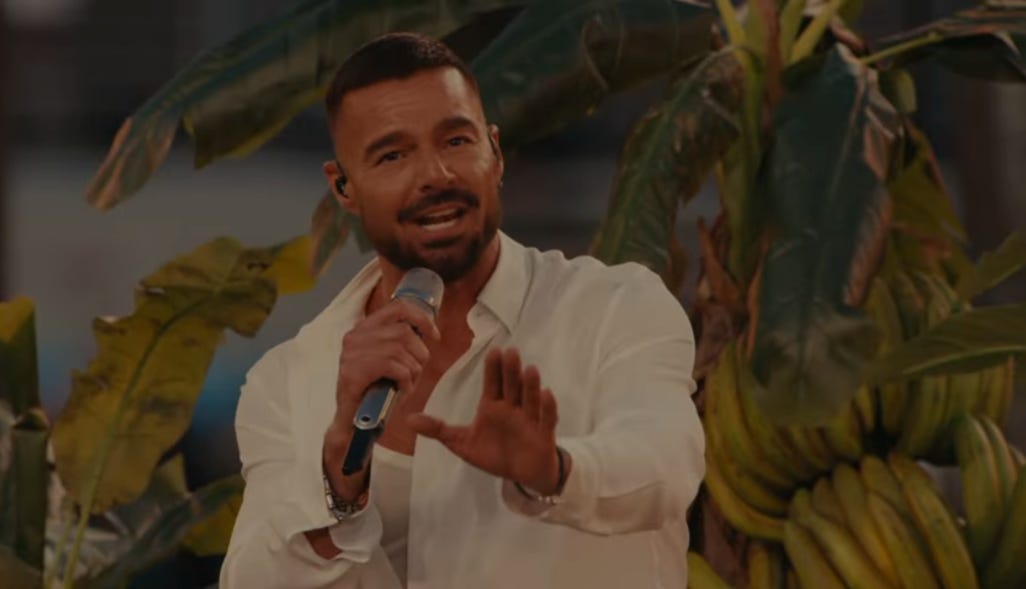
And if you can believe it, he did not stop there. Next we are surprised by our next guest performer, the iconic Ricky Martin, a Latin pop trailblazer for his talents, impact, and social legacy. Martin joins the show to sing the thesis refrain from the most overtly anti-colonial ballad on “Debí Tirar Más Fotos,” “Lo Que Pasó a Hawaii,” where Bad Bunny, now Martin, sings “No quiero que pase contigo lo que pasó a Hawaii,” (“I don’t want what happened in Hawaii to happen to you”). It bears stating that Martin crossed over from Spanish-language charts in the 1990s, during a multi-cultural boom in US culture. However, in this moment, it was less acceptable for artists of color to voice overt political beliefs. The impact of having Martin sing this verse is that it rejects the notion that US culture can extract performative, desirable labor from “Latin lovers” without respecting their full humanity. Similar to the ways in which the sovereignty of Hawaii and Puerto Rico continue to be violated in the service of becoming tourist playgrounds, Martin and performers like him (even NFL players) have been forced into partial inclusion in the US cultural landscape, only supported in so far as they promote mainstream US “good feelings.”
As a U.S.-Latinx literary scholar by training, the finale to me evoked the long-standing racist, xenophobic “immigrant invasion” trope that has been applied to immigrants from the Global South—Asia, Latin America, South America, and the Middle East, especially. We can think here of recent racial scripts that invoke terrorism in the wake of 9/11, and disease during the COVID-19 pandemic. When immigrants are seen as unassimilable, dominant society views this as a threat. So for Bad Bunny to craft a literal stream of Latin and South American national flags, moving directly and unflinchingly towards the camera, as Bad Bunny also advances closer to the spectator’s gaze, I was impressed that he would so boldly craft a scene that can be interpreted as a confrontation.
All the while, Bad Bunny grips the football, revealing the message, “Together, we are America.” After naming each country from Latin and South America, he simply says, “Seguimos aqui,” (a forward-looking way to say “We’re still here”—readers can correct me on this translation). In her work on Puerto Rican performance art, Sandra Ruiz puts forth the notion of “endurance” as central to Puerto Rican identity, particularly as it is performed in public. Ruiz writes that endurance “is about laboring to eventually stare past the horizon with apprehension, longing, pain, and pleasure—no feeling invalidated by another in the long pursuit of liberation and continual existence” (Ruiz 16). By ending on these simple words, Bad Bunny invited all Latinx people into this mode of being—one that endures despite incredible suffering and constraints.
I want to end with a brief consideration of the constraints and purpose of a performance like this. It’s critical to remember that the fiction of the United States as a nation relies on the careful curation of a social order created by and for white, straight, upwardly-mobile men, and that public spectacle threatens that order because it intervenes in ideas of “cultural consensus,” or the idea that we all believe that the current social order is right and good. Bad Bunny achieved a lot with this performance, and I truly found it to be both politically incisive and artistically moving. I saw a lot of citationality not just with Puerto Rican and Caribbean history, but also with a rich tradition of US-Latinx and hemispheric artists like the poet Pedro Pietri, and many others.
Art is necessary in social movements. It allows us to connect, to reimagine social order, and to reenergize. But spectacles like the Super Bowl are not predictors of social change in themselves. They are sustenance to be savored, a hearty meal that can then be converted into the fuel we need to keep going. Maybe this performance gives us language to have difficult conversations, or the pep in the step you need to remember that if you’re reading this, or reposting clips, we are not the ones who get to feel despair. We are the ones who must call representatives, fundraise, speak out, offer mutual aid, and work every day to dismantle the systems Bad Bunny, as an artist, helps us understand. I am grateful for meaningful art from Latinx creatives, we need it. I am deeply grateful and it is only one part of the important work ahead.
Works Cited
McMaster, Gerald. “Colonial alchemy: Reading the boarding school experience.” Partial Recall: Photographs of Native North Americans (1992): 77-87.
Mintz, Sidney. Sweetness and Power: The Place of Sugar in Modern History. Penguin Books, 1986.
Ramírez, Catherine S. Assimilation : An Alternative History. University of California Press, 2020.
Ruiz, Sandra. Ricanness: Enduring Time in Anticolonial Performance. NYU Press, 2019.
Vargas, Deborah R. “Ruminations on Lo Sucio as a Latino Queer Analytic.” American Quarterly, vol. 66, no. 3, Sept. 2014, pp. 715–26.
Some further reading for Bad Bunny Halftime, specifically
Aparicio, Frances R., and Susana Chávez-Silverman, editors. Tropicalizations: Transcultural Representation of Latinidad. University Press of New England, 1997.
Negrón-Muntaner, Frances. Boricua Pop: Puerto Ricans and the Latinization of American Culture. NYU Press, 2004.
Pietri, Pedro. Puerto Rican Obituary. Monthly Review Press, 1973.
Stunning!!!! Gorgeous, Beautiful, reading. I will say I interpreted “seguimos aquí” as “we’re staying here”, a translation that I think adds to your point about immigrant “invasion” and the general around ICE and his project of refusing erasure.
You bodied this analysis 🔥🔥🔥🔥 thank you for this beautiful thorough piece. Indeed this was a push for me to further hold onto hope and authenticity as a latina in my art and with community